Ethics
Skeptical about AI in schools? So are we.
How we think about student data, guardrails, and the edtech AI rush, and where a person checks what the machine produces.
By Chris McNutt··4 min read

Being intentional about AI has mattered to us since before we built anything. We keep a public position statement on how we use AI: what happens to student data, where a person checks what the system produces, and the parts we still haven't solved.
Plenty of edtech has rushed to bolt AI onto everything, and some of it is genuinely unsafe for the kids (and adults) using it. We're trying to do this differently.
The edtech AI rush is moving too fast
Anyone can wrap a chatbot in a tidy interface and call it a product. Whether it's a pre-prompted AI device or a ChatGPT clone with a school's logo on it, the bar for shipping something that looks finished is close to zero. So a lot of it plays loose with children's data and sounds far more certain than it should. And even when a bot in the bottom-right of the screen isn't outright dangerous, it's often just "slop": not very useful, and not going to transform anything in education.
Anything AI-driven carries real risk, and it needs rules and guardrails. The EU AI Act now treats education AI as high-risk and bans emotion-inference systems in classrooms outright. We started building Polaris around human oversight before that law existed.
We don't sell student data, and we don't train on it
Polaris is incorporated under our nonprofit, Human Restoration Project. Our charter forbids selling or handing off student data, and that holds even if we dissolve, merge, or get acquired. We never use student responses to train AI models, and the contracts we hold with our model providers keep customer inputs and outputs out of AI training.
We strip personally identifiable information out of our empathy interview reports. Polaris is FERPA, COPPA, and CIPA compliant, and Common Sense Privacy rated us 95% in an independent evaluation.
Common Sense Privacy rating
compliant
records sold or used for training
Stays inside Polaris — encrypted, anonymized, school-controlled:
- Encrypted in transit and at rest
- PII stripped before entering reports
- Voice anonymization on request
- Visible only to permitted school staff
- Deleted on district request
Never happens — prohibited by charter or vendor contract:
- Sold to third parties
- Used to train AI models
- Shared with marketers or advertisers
- Transferred on merger or acquisition
- Released without legal process
A model's output is a draft, not a verdict
Some vendors pitch AI as a closed loop: the system takes student input, decides what it means, talks back to the student, then hands the school its conclusions with no one in between. We think that's the wrong design. Every stage of our pipeline has a person checking the machine:
- Question authorship. Teachers and administrators decide what students get asked.
- PII review. Automated redaction runs first, then a person checks the edge cases.
- Quote-to-audio verification. We check a sample of quotes against the original recording before a report ships.
- Safety-flag review. Possible safety concerns go to a teacher.
- Final sign-off. Polaris drafts the initial report. A person publishes it.
Every student quote in a published report links straight back to the recording it came from, so any finding traces to what a student actually said.
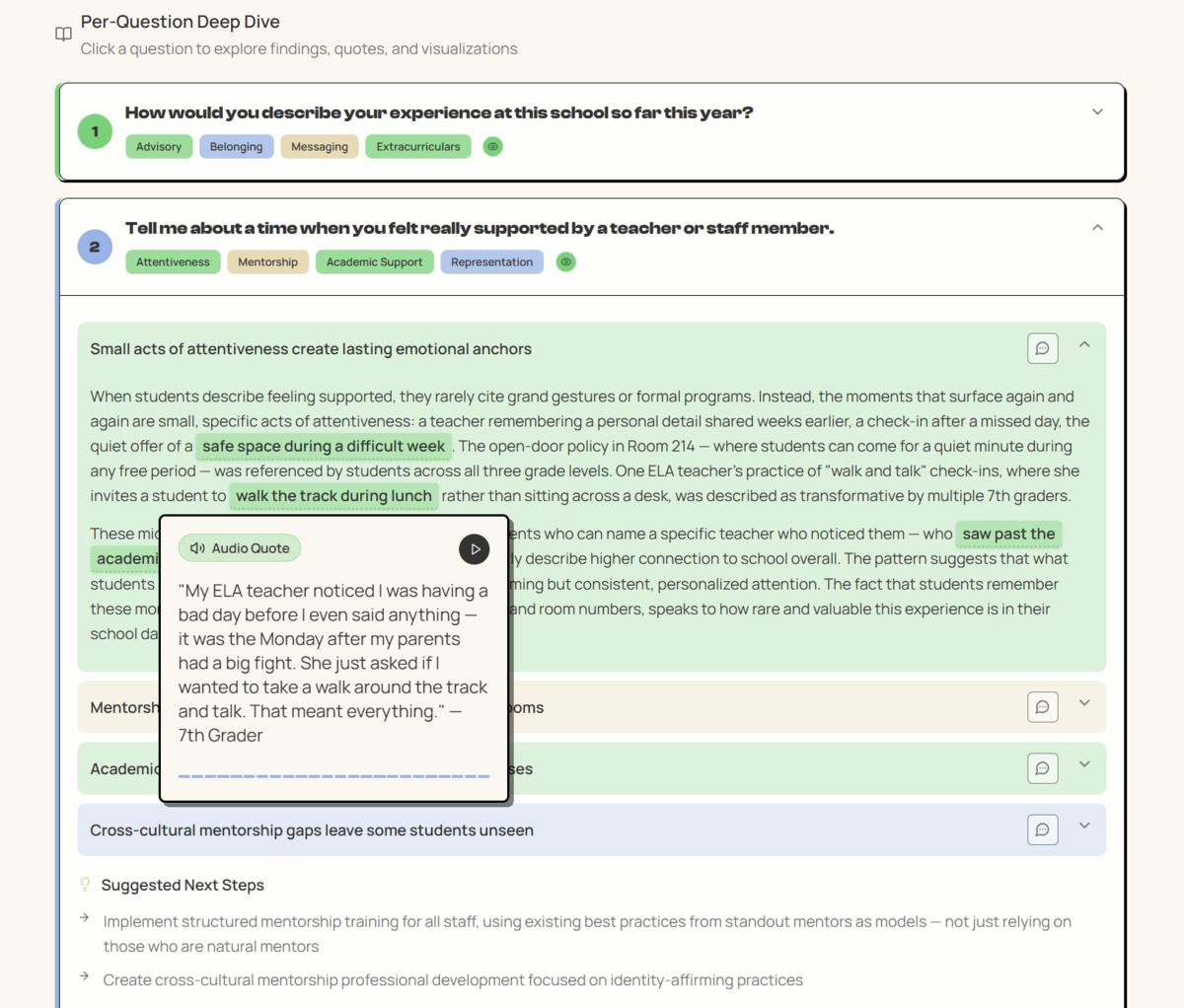 Open any quote and hear the recording it came from.
The environmental cost is real, so we keep it small
Running AI costs real energy and water, and we don't pretend otherwise. We use providers powered by renewable energy, run scale-to-zero compute so we only draw power during the seconds a job is actually running, and batch and cache our work so we don't process the same thing twice. The IEA expects data-center electricity use to roughly double by 2030. At our size, the honest moves are to pick smaller models when they're enough and to stop recomputing what we've already computed.
It's okay to be skeptical, but the right use cases are real
The criticisms of AI hold up. Hallucination, bias, and energy cost are all real and documented, and we build around them instead of pretending they're not there. But pointed at the right job, these tools do things that weren't possible before. A district running fifty listening sessions produces more student talk than any superintendent could sit and listen to. Polaris pulls out the patterns, and the actual student quotes underneath them, and puts them in front of the people making decisions, with the original audio a click away.
We lean solarpunk: technology should serve people and the planet. Anyone can pre-prompt a chatbot. We'd rather raise the bar and build something that actually saves educators time and carries student voice into the decisions schools really make.
The report screens shown above use sample data for illustration, not real student responses.
Want to hear from your students?
Polaris is opening to new districts for the coming year. We will walk you through a real report and what a season of listening could look like in your schools.
Read next

We listened...now what do we do?
How educators and student leaders can make sense of hundreds of conversations and turn what they heard into action.

By the time the data comes back, they've moved on
Lagging indicators, feedback loops, and what we're actually building toward when listening becomes an ongoing dialogue instead of an annual event.

You don't get answers like this from a survey
What thousands of students said when we asked real questions.